
Every weekend I plan the week ahead, and every weekend that means bouncing between Calendar and Reminders on my Mac and my iPhone. There are apps that fix this. They show both side by side and let you drag a task into an empty slot on your calendar so it actually gets done. Every one of them wants a subscription.
I've hit my limit on subscriptions. I don't mind paying for good software. I mind paying for it every month, forever.
I'm not alone. Deloitte's Connected Consumer survey found that 28% of Americans now describe managing their devices and subscriptions as overwhelming, up from 24% in 2022. So I did the thing I keep telling other people to do. I built it.
One week later, Taskical is sitting in App Store review. This is what the week looked like, what it says about where the models are, and why I think the lesson has nothing to do with calendars.
The weekend, in order
Saturday morning: design. Three or four hours in Claude Design producing a high-fidelity wireframe. This is the part I refuse to hand off. Every decision about what the app does and how it feels was made here, before a line of code existed.
Saturday afternoon: handoff. I gave the design to GPT-6 Astra and asked for a native macOS app. Another three or four hours to a first working build. After that it was a running list of tweaks and fixes, most of them happening in the background while I did other things.
Sunday: everything around the app. An app that only runs on my machine proves nothing, so I decided to publish to the Apple App Store, which puts a human reviewer and a set of automated checks between me and the public. While that was in motion I built a website to sell it, with analytics, conversion tracking and an admin panel for turning user feedback into builds and releases. Registering taskical.app , deploying, wiring mail through Google Workspace and setting up Google as the identity provider took about an hour.
Roughly eight hours in total, most of it asynchronous. By Sunday night the app worked exactly the way I intended. It just couldn't ship yet.
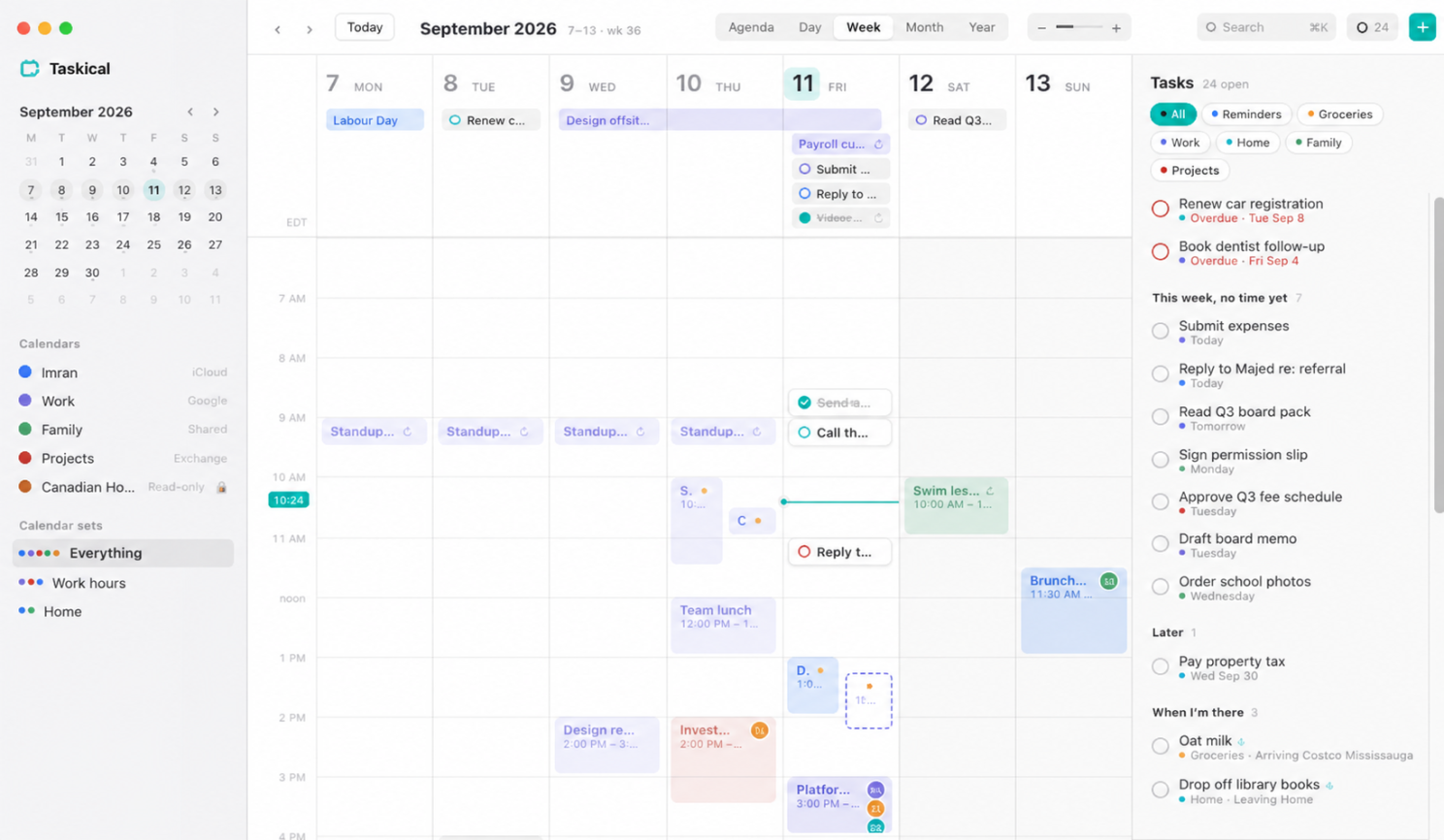
Taskical for Mac. Events stay in Calendar, to-dos stay in Reminders, and things get done because we find time for them.
Computer use grew up
The moment that stuck with me was small. After settling on the icon, I needed a layered version built in Xcode's Icon Composer to match Apple's Liquid Glass spec. I had never opened Icon Composer. I handed Astra the image, told it what I wanted, and walked away. Ten minutes later the icon was done, built in front of me, in a tool I'd never touched.
A year ago my first attempt at computer use was too slow to do anything meaningful. Now it's fast enough to delegate the tedious, GUI-bound work that used to be the hard floor of "you have to do this part yourself." That floor moved.
The week the weekend didn't cover
Building the app was the fast part. Getting it to sync with the calendars and reminders people actually use took another two or three days of back-and-forth, and none of that time went into code.
Taskical reads and writes Apple Calendar and Reminders through EventKit, which is the easy case: the user grants permission once and macOS handles the rest. Sending invitations through the account that owns the calendar is a different story. Google wants an OAuth consent screen and a verified app before it lets strangers grant calendar access. Microsoft wants an app registration in Entra with the right Graph permissions, and for a work tenant, an administrator's consent on top. iCloud has its own path. Three identity providers, three permission models, three sets of edge cases. None of it hard, all of it slow, and most of it waiting on forms, verifications and test accounts rather than on the agent.
Then the App Store. Listing an app means a chain of registrations, agreements and declarations. Developer program, banking and tax forms, the privacy questionnaire that becomes the label on the store page, a sandbox declaration for every capability the app touches. None of them takes long on its own, but each one demands reading before you can answer the questions properly. The agent can draft the answers. It can't sign the agreements, and it can't know what my app does with the network unless I tell it.
I submitted a week after I started. The review came back in a couple of hours, and it was a rejection. Apple's guidelines say Mac App Store apps must be appropriately sandboxed, and Taskical asks for a network entitlement so it can run a few validations. My submission didn't explain why well enough. The reviewer wanted the reason, in writing, before letting the app through.
That's fair. I'm working through it now, and it's exactly what I wanted from the process. A reviewer refusing to take network access on faith, before a stranger downloads the app, is the outside scrutiny I went to the App Store for. It's cheaper to be rejected for a missing explanation than to ship with a hole nobody asked about.
Idea to App Store review in one week. Two evenings of that were the app. The rest was the last mile, and the last mile is where most weekend projects quietly die.
What the week says about the models
I've written before about harness engineering and about parallelizing the waiting. This week was both of those in miniature, and it clarified one thing for me.
The agent's job was never the eight hours. It was the other hundred and sixty. Astra held the execution state for a week: the build, the tweaks, the fixes, the icon. I stepped in when a decision needed a human and stepped out again. The design was serial and mine. Everything downstream ran while I did something else.
That's the shape of the productivity gain, and it's why the "eight hours" number is both true and misleading. The eight hours is my attention. The week is the calendar time. What the models bought me was the gap between the two, and a year ago that gap didn't exist because the agents couldn't be trusted alone for more than a few minutes.
Two labs, two models, one project: Claude for the design, Astra for the build and the computer use. Both did what I handed them, and neither did the parts I didn't. That's the current frontier, and it's a good place for it to be.
The takeaway isn't the app
Taskical will be on the Mac App Store once review clears. Until then, the site is up at taskical.app . Take it for a spin when it lands and let me know what you think.
But the point of this week wasn't a calendar app. It was a benchmark of where the frontier models are. If one person can go from idea to a native app under App Store review, with three provider integrations and a commercial website, in a week, the economics of tooling inside an organization have changed.
Calendar and Reminders aren't the point either. Every organization I've worked in has staff bouncing between three or four systems to finish one piece of work, and the gaps between those systems are where the day goes. The pension administrator with the plan system in one window, the document repository in another and a spreadsheet for the piece neither system handles. The analyst re-keying numbers from one platform into another because the export was never built. Every one of those gaps is a Taskical waiting to happen.
In the rush to become agentic, AI-first organizations, we keep reaching for agents to close those gaps. Many of them are more easily closed with a better tool in the hands of a person who already has the judgement, the experience and the accountability. An agent can't bring those. It can only borrow them.
That's the flip side of agentic operations that gets less airtime. Every agent you deploy opens a question about who owns the decision, who's accountable when it's wrong, and what guardrails and governance sit around it. Those are real questions and they deserve real answers, and I've spent enough time in governance committees to know how long the answers take. A better tool for your staff doesn't open that question, because the person using it already owns the answer.
So before the next agent proposal lands on your desk, ask a simpler one first. Is this a job that needs a new decision-maker, or a job where the decision-maker already exists and just needs a better window into the work? The second kind is more common than the first, and it's the kind you can now build in a week.
Bespoke tools that fit the way a team actually works used to mean buy something generic or wait in the IT backlog. They're now within reach of anyone with a little knowhow and some experience shipping software.
Don't just ask what agents can do for your people. Ask what you could build for them.