
The two traps of enterprise AI
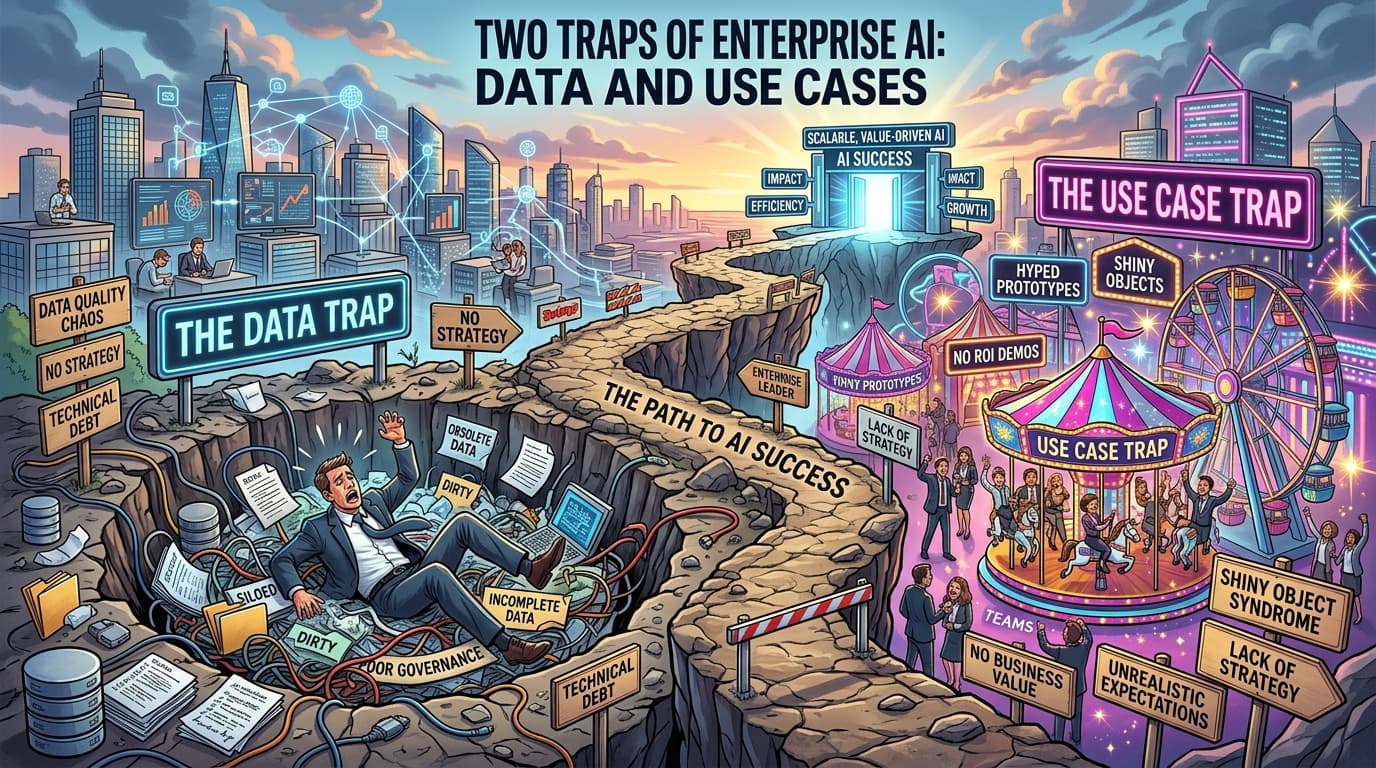
Most enterprise AI strategies start from one of two assumptions: get your data right first, or find high-value use cases. Both sound reasonable. Both are traps if you treat them as step one in a linear playbook.
The data readiness myth
The conventional wisdom goes like this: clean up your data, build your pipelines, establish governance, then start doing AI. Gartner predicted that through 2026, organizations would abandon 60% of AI projects unsupported by AI-ready data. That stat gets cited in every board deck. And it's not wrong. Data quality matters enormously. The problem is what organizations do with that information.
They launch multi-year data transformation programs as a prerequisite for AI. They treat data readiness as a gate, not a companion. And by the time the data estate is "ready," the AI landscape has moved three generations ahead of the plan they wrote.
The World Economic Forum put it well in a January 2026 piece: instead of starting with isolated use cases, the conversation must begin with business priorities and address data readiness strategically alongside them. Not before. Not after. Together.
McKinsey & Company's latest numbers tell a similar story. 88% of companies are using AI in at least one business function. But only about one in ten has successfully scaled AI agents beyond pilots. The bottleneck isn't that these companies haven't started cleaning their data. It's that data readiness and use case development are being treated as sequential activities when they need to be parallel.
The organizations getting this right aren't waiting for perfect data. They're picking a specific problem, discovering what data they actually need for that problem, and fixing that data in context. The use case drives the data work. Not the other way around.
The use case discovery gap
This brings us to the second trap: finding high-value use cases. Everyone agrees this matters. Deloitte's 2026 State of AI report found that the AI skills gap is the single biggest barrier to integration. But that framing obscures a more specific problem.
In most enterprises, AI skills live in IT. Domain knowledge lives in the business. These two groups don't naturally collaborate on problem discovery. The result is predictable: AI initiatives get pushed by technology teams solving problems they can see from the IT vantage point, not by operations people, underwriters, portfolio managers or supply chain leads articulating the friction in their actual workflows.
A CIO Online article from late 2025 described this dynamic precisely. Business units want to move quickly with AI and they will, with or without IT's involvement. But few organizations have the centralized resources to meet that demand. The proposed solution, a hub-and-spoke model where IT provides platforms and guardrails while business units own delivery, is the right architecture. But it only works if the people in the spokes have both the domain expertise and the AI literacy to identify what's worth building.
Contrast this with what's happening in startup culture. Solopreneurs and small teams with deep domain knowledge are coupling that expertise directly with AI tools. They don't have an organizational gap to bridge. The person who understands the problem is the same person building the solution. They move fast, iterate in real time and ship things that work because the feedback loop between domain insight and technical execution is measured in hours, not quarters.
Enterprises can't replicate that model at scale. But they can learn from it. The pattern that works is not "IT builds AI solutions for the business." It's "domain experts become AI-capable, supported by centralized platforms and governance." Info-Tech Research Group's 2026 CIO Priorities report flagged data governance as the single largest capability gap across enterprises, with a 2.8-point spread between importance and effectiveness. Their recommendation: federated models that assign accountability to domain experts while maintaining centralized standards.
What actually works
The organizations making real progress on AI aren't following a linear path from data readiness to use case discovery to implementation. They're running these workstreams in parallel, driven by a few common patterns.
- They start with a specific business problem, not a technology scan.
- They fix the data they need for that problem, not the entire data estate.
- They embed AI skills into business teams, not just IT.
- They build governance and platforms that enable distributed experimentation without distributed chaos.
Deloitte's survey of 3,235 leaders found that only 34% of organizations are truly reimagining their business with AI. The rest are optimizing what already exists.
The difference isn't model selection or data maturity. It's whether the people closest to the work have the skills and the authority to identify where AI changes the game.
The playbook is simple but hard. Stop treating data readiness as a prerequisite. Stop letting IT own use case discovery alone. Close the gap between where AI skills live and where domain knowledge lives. That's where the real work is.
Join the discussion on LinkedIn.